



River and Coastal Erosion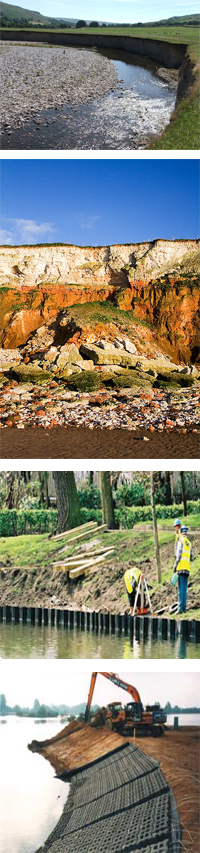
River bank and coastal erosion are naturallly occuring processes which can result in loss of land, and when severe, can threaten property and infrastructure. The release of eroded material into river systems can, through downstream accumulations, impede flows and increase flood risk.
In both river and coastal situations higher velocity flows and increased wave action remove the softer bankside and cliff face material. Once established the erosion very often accelerate under similar, and even less severe conditions.
Hard Engineering
Securing the toe of the river bank or cliff face is an essential requirement in seeking to control the erosion and slippage. This is achieved through piling, concrete/timber revetting, gabions etc., above this stable toe the eroded face, after re-shaping, can be armoured with blockwork or similar. To reduce the wave action a number of robustsystems are availableto create turbulence and reduce energy in advance of the wave meeting the cliff face. Groynes can also be installed to, in effect, trap sand and elevate beach levels.
Soft Engineering
Many approaches can be taken some of which can provide a positive benefit to the wildlife habitat. Sand dunes, vulnerable, to both waves and wind, can be stabilised by establishing a vegetation cover using suitable grass species, unstable faces can be secured using vegetated geotextiles, Pressure on sensitive eroding areas can be reduced by providing water space by creating wetland areas and extending salt marshes.
Related legislation and Guidance:
Flood & Coastal Erosion
The National Flood & Coastal Erosion Risk Management Strategy for England
Flood and Water Management Act (2010)
Marine and Coastal Access Act (2009)
Related Products and Services